
When Joseph Rigdon’s mother was diagnosed with breast cancer, she and his father turned to medical studies to understand her treatment options. They read about benefits, risks and outcomes, then talked with her care team about what those findings might mean for her.
But even with that information, an important question remained: Would a treatment that helped patients in a study offer the same benefit to her?
Rigdon was a graduate student at the time. His mother’s experience stayed with him as he began a career helping researchers and physicians interpret medical data. Behind every study’s overall findings, he saw another set of questions about the people those findings were meant to help.
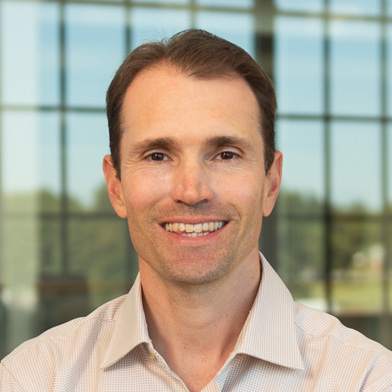 |
“Will it work the same for everyone? Are there certain groups of patients that might benefit more or less?” — Joseph Rigdon, Ph.D., associate professor of biostatistics and data science |
Today, those questions guide his work as an associate professor of biostatistics and data science at Wake Forest University School of Medicine.
Rigdon is one of six faculty members selected as a Dean’s Research Scholar for 2025-26, a program that highlights outstanding mid-career faculty whose research is advancing scientific discovery and improving human health. Through resources, mentorship and leadership opportunities, the program supports scholars as they advance their research and its potential impact.
For Rigdon, that impact begins with helping patients understand how medical evidence relates to their own lives.
Why it matters
A clinical trial can help establish whether a treatment works, on average, for the people who participated. But that overall result may not tell the whole story. Some groups of patients may benefit more than others.
Understanding those differences could help patients and clinicians have more informed conversations about treatment. It could also help researchers develop clinical guidelines that better account for the people receiving care.
Rigdon encountered these questions across studies he supported, including research comparing low-carbohydrate and low-fat diets at Stanford University. The work reinforced his interest in understanding which approaches might work best for which groups of people.
His goal is to develop methods that can uncover those differences and present them in ways people can understand. For a patient weighing treatment options, knowing a study’s overall result is useful. Understanding how that result may apply to people with similar characteristics could make it more meaningful.
Finding patterns, making them visible
Rigdon and his collaborators are developing statistical methods that use matching and decision trees to identify groups of patients who may benefit more or less from a treatment.
A decision tree organizes information into branches, making patterns within a dataset easier to follow. Rigdon sees the potential for these visualizations to help patients understand where people like them fit within a study’s findings.
With support from the Patient-Centered Outcomes Research Institute, or PCORI, his team is developing and testing the methods. The work includes comparing their approach with other methods in simulated datasets and gathering patient perspectives on different visualizations.
The long-term goal is to give patients another way to engage with research beyond reading a scientific abstract filled with technical language.
A patient could look at a picture, Rigdon said, “and really see themselves in the data and where they might land in that picture.”
Those insights could add another dimension to conversations with a physician. They could also help researchers who bring together findings from multiple studies to inform clinical guidelines. If differences among patient groups become easier to identify and compare, Rigdon hopes guidelines could eventually reflect those differences more clearly.
A path from math to medicine
Rigdon’s interest in asking questions began long before his research career. Growing up in the Carrboro area of North Carolina as the oldest of five siblings, he remembers dinner conversations filled with ideas, debate and different ways of thinking.
He loved calculus in high school, but it was his mother who introduced him to a way to connect mathematics with human health. Years earlier, while studying art history at the University of North Carolina at Chapel Hill, she worked in the Department of Biostatistics. She suggested he explore the field.
Rigdon went on to earn his undergraduate, master’s and doctoral degrees at UNC-Chapel Hill — a triple Tar Heel. After five years as a biostatistician at Stanford, he joined the School of Medicine in 2019, drawn in part by the opportunity to lead his own research.
He also leads the Biostatistics, Epidemiology and Research Design, or BERD, group, helping investigators across the School of Medicine design studies and build their research programs. Supporting early-career researchers as they secure funding and time to pursue their work is among the accomplishments he finds most rewarding.
That role extends his impact beyond the methods he develops himself, helping other investigators ask and answer questions that matter to their patients.
The next question
Developing a useful method is one step. Making it available when patients and physicians need it is another.
Rigdon is exploring how the visualizations might eventually appear alongside scientific publications or become accessible through electronic health records. That broader effort may require a separate project once the current methods have been developed and tested.
He is also studying how information already in electronic health records could help create a more complete picture of a person’s health. The work is still taking shape, and missing information and biases in those records present challenges. But the purpose is familiar: making complex data more useful to the people it describes.
What gives him hope
Rigdon’s mother is doing well today. The questions his family faced during her treatment continue to shape what he hopes to accomplish.
He thinks about future patients in her position — people trying to understand unfamiliar research while making decisions that carry enormous weight. Giving them clearer information could help them take a more informed role in conversations with their care team.
For Rigdon, the promise lies in connecting the data people contribute to research with information they can use in their own care.
“I know it’s an ambitious goal and it would change a lot of the way science is done,” he said. “I’m just one small person, but thinking of how to put the pieces together to make something like that happen is really exciting.”