The Sports Injury Biomechanics Lab at the Wake Forest Department of Biomedical Engineering advances research aimed at understanding, preventing, and managing sports-related injuries through interdisciplinary approaches.
Building on the Wake Forest School of Medicine’s leadership in sports injury research, the lab examines how head impact biomechanics and exposure relate to neurobehavioral outcomes, alongside complementary work in musculoskeletal injury mechanisms, rehabilitation, and performance. It also integrates biomechanical insights with health behavior and implementation science to inform the design, implementation, and evaluation of injury prevention strategies in real-world settings.
Our Research
The lab integrates field-based measurement, advanced sensing technologies, and computational modeling to characterize how biomechanical forces arise during athletic activity and how they vary across sports, environments, and levels of play.
These insights are then translated into practical interventions – spanning technique refinement, equipment innovation, and strategies developed with input from athletes, coaches, and clinicians – using a community-engaged approach to mitigate injury risk and improve neurological and musculoskeletal outcomes.
COACH Program Collaborates with Community to Reduce Head Impact Exposure in Youth Football
The COmmunities Aligned to Reduce Concussion and Head Impact Exposure (COACH) initiative is an evidence-informed intervention program co-designed with the community. It translates biomechanical research into practical guidance for safer sport participation, equipping coaches with tools to design practices to reduce injuries and reinforce effective technique. By combining hands-on learning, guided practice planning, and mentorship, COACH aims to reduce head impact exposure while preserving skill development and on-field performance.
In practice, COACH seeks to prevent head impacts and reduce concussion risk in youth football by:
- Improving coaches’ knowledge and skills in practice planning while shifting attitudes toward contact in practice
- Providing guided practice plans, coaches’ clinics, and peer mentorship to support implementation
- Fostering relationships across high school and youth football communities, including partnerships with local organizations such as the Piedmont Youth Football and Cheer League (PYFCL)
Football Safety Clinic
As part of the ongoing youth football research study, Jillian Urban, PhD, MPH, has been working with a team of stakeholders in the local youth football community to develop an intervention program to reduce head impacts and concussion risk in practice. To best reach youth football coaches, Urban and her team coordinated an event where local high school coaches could educate youth coaches on effective practice planning and how to incorporate different drills in practice to develop the skills of athletes, and keep them safe.Jill Urban
The event today is a clinic for youth football coaches within the Piedmont Youth Football and Cheer League, and it's put on by the Wake Forest University School of Medicine in collaboration with local high school football coaches, and it's really aimed to give youth football coaches the knowledge and skills that they need to safely instruct their athletes on the field. We've got a moderated coaches panel where the high school football coaches are talking about how to plan a practice. We've got some sports medicine talks where we're talking about concussions, heat illness, cardiovascular events in sports, and then we have drill demonstrations where the coaches are going to come around and see Wake Forest football players demonstrating different safe practice drills that they can use in their own practices.
Josh McGee
An opportunity for us as high school coaches to really give back to our youth programs. The youth programs are such an important part to kids when they get to high school, and a part of our football programs, and anything we can do to help give back and enhance their knowledge to make our kids better when they get to us, we're all for it. This goes back for us at Reagan High School to 2012 when we did the helmet study with our program for four or five years, and I just think it's allowed the school to do more research and find ways to make the game safer. When we have a group of people that have a passion for making it safer, I think it's going to make our game that much better.
Rob Patterson
Our partnership has resulted in a higher knowledge of the risks that are involved, the inherent risks that are involved with football, and how we can mitigate those by reducing distances in practice drills, changing tackling techniques, focusing more on those techniques than on the big hits. All the data and the instruction that's being provided from this study and from Wake Forest and the School of Medicine is vital in making sure that our kids maintain a high level of competitiveness, but a low level of risk. Thank you very much for everything that Wake Forest does for us, for youth football, for our coaches and the education of not only safe practices, but the longevity of this game that's going to occur because of everything that this study and this information is providing.
Collaboration with UNC–Chapel Hill Aims to Reduce Head Impacts and Improve Safety in Youth Ice Hockey
A collaborative research project between the lab and the University of North Carolina at Chapel Hill is examining how head impact exposure in adolescent boys’ and girls’ ice hockey relates to athlete characteristics, play context, and neurobehavioral outcomes.
Using innovative mouthpiece-based sensors, synchronized video analysis, and neurobehavioral assessments, the study applies advanced methods to comprehensively characterize head impact biomechanics in this population. It also evaluates community awareness and receptivity to using biomechanical data to inform safety strategies. Together, this work aims to generate actionable insights to reduce head impact exposure and improve safety in youth ice hockey.
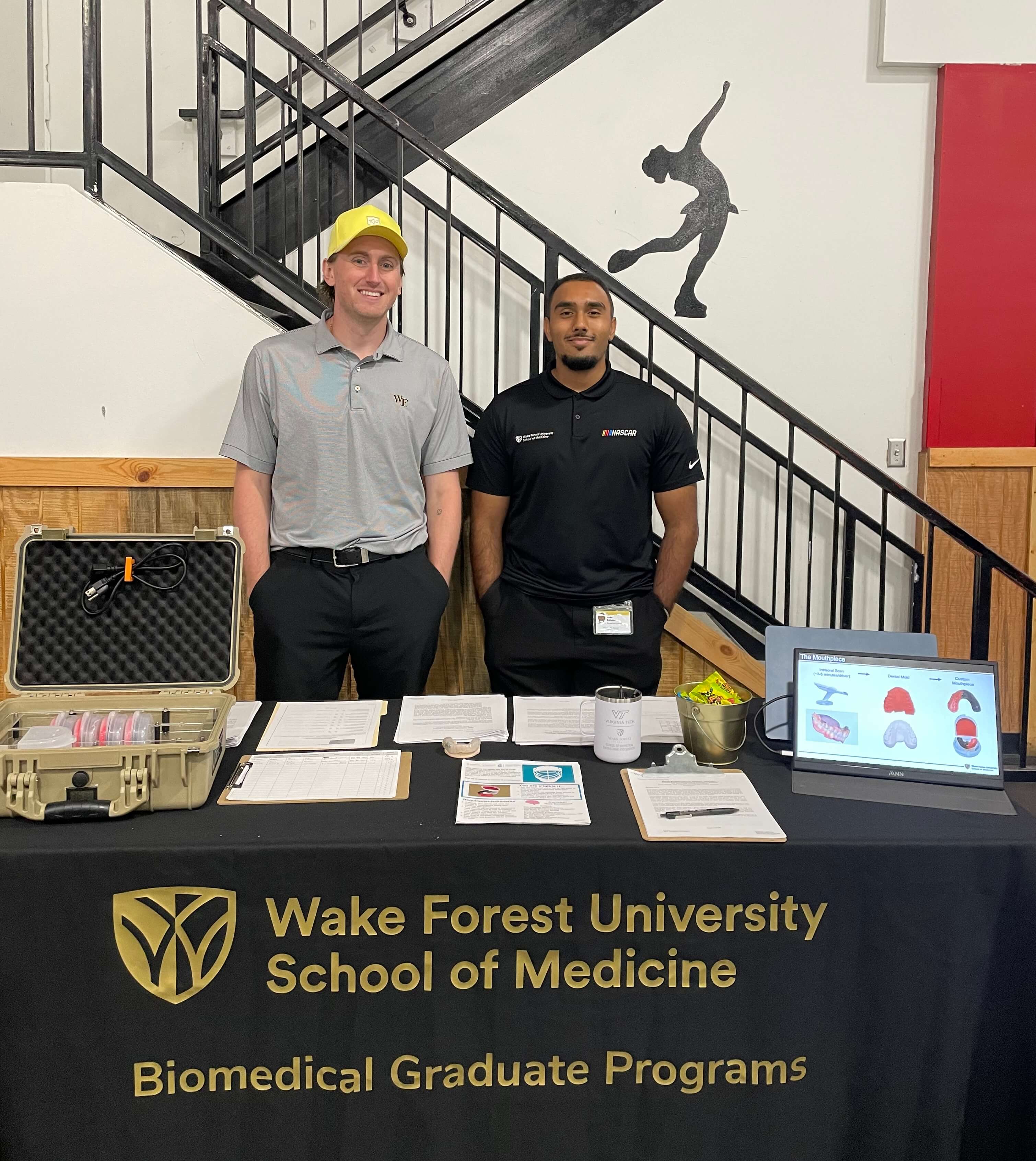
Partnership with NASCAR Drives Safety Forward by Turning Real-World Head Impact Data into Smarter, Safer Motorsports
The lab is partnering with NASCAR to study driver safety through advanced head impact biomechanics research. Using instrumented mouthguards, researchers collect real-time data on head acceleration and forces experienced during races, capturing both crashes and routine driving exposure.
This work helps quantify cumulative head impact exposure and identify potential risks beyond major collisions. The findings are used to inform improvements in vehicle design, track conditions, and safety protocols. Ultimately, this collaboration aims to translate biomechanical insights into practical strategies that enhance driver safety in motorsports.
Lab Researchers Develop REBOUND Concussion Protocol to Guide Gymnasts Back to Sport
 To help gymnasts safely resume training after concussion, the lab developed a sport-specific pathway informed by head motion data, clinical guidance, and input from the gymnastics community. Using safe, wearable mouthpiece sensors, researchers partnered with local coaches and athletes to better understand head motions during gymnastics skills and combined these real-world data with current concussion guidelines and lived experience.
The result is the REBOUND protocol, a set of easy to use resources designed for parents, coaches, athletes, and medical professionals that speaks a shared language and supports safe, confident progression back to gymnastics. REBOUND breaks recovery into clear, sport specific stages and provides practical guidance on when to advance, when to pause, and when to check back in with a healthcare provider. This community driven approach aims to make concussion recovery safer, clearer, and more supportive for everyone involved in a gymnast’s care.