
Heart failure can develop long before a patient receives a diagnosis. Hidden in routine health data may be clues that something is wrong, but those clues are not always apparent to clinicians reviewing a test or examining a patient. Finding them earlier could create an opportunity to investigate sooner and determine what care a patient needs.
That possibility drives the work of Oguz Akbilgic, Ph.D., a professor in the Department of Cardiovascular Medicine at Wake Forest University School of Medicine. He develops artificial intelligence models that look for patterns in health data, with the goal of helping clinicians detect disease and anticipate health risks.
But identifying a pattern is only part of the challenge. Akbilgic wants to turn those discoveries into tools that clinicians can use.
“I want to do actionable AI,” Akbilgic said. “Develop AI models that can change the trajectories of patients in a positive way.”
Akbilgic’s work earned him recognition in the Dean’s Research Scholars program, which highlights outstanding mid-career faculty whose research is advancing scientific discovery and improving human health. For Akbilgic, the recognition provides encouragement to keep pursuing a practical question: How can AI help patients receive better care?
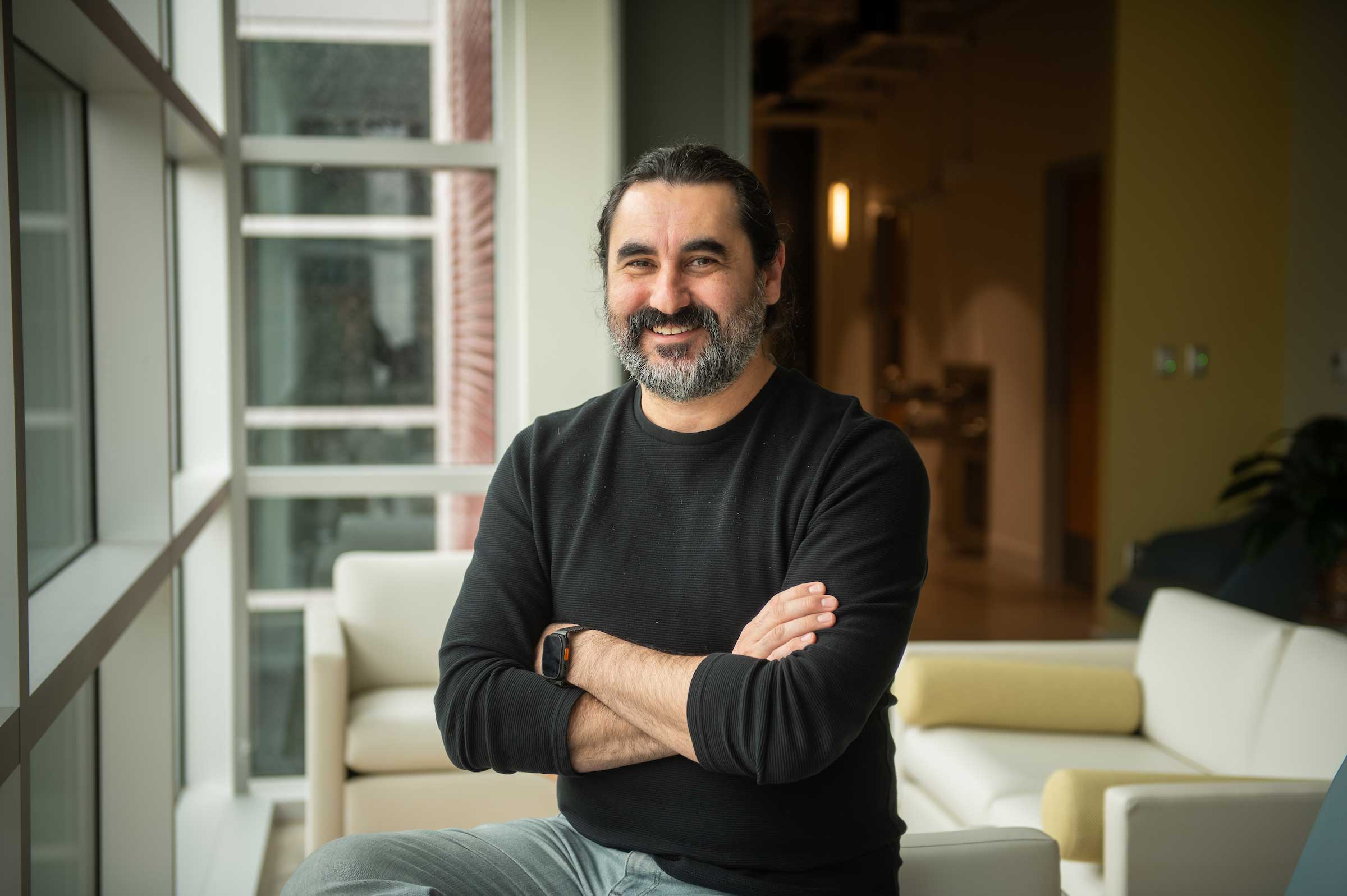
“I don’t want to retire in 20, 25 years, look back, and find that none of the AI models I developed ever touched any patient.”
— Oguz Akbilgic, Ph.D., associate professor of cardiology
Why It Matters
Akbilgic’s path to healthcare began with mathematics.
Trained at Istanbul University and Mimar Sinan University in Turkey, he became interested in statistics, decision-making and neural networks, a type of AI that learns patterns from data. His early work took him into finance and the oil and gas industry. He enjoyed developing the methods but wanted the results to serve a purpose that felt more meaningful to him.
That search led him to biomedical informatics in 2015 at the University of Tennessee Health Science Center in Memphis, then to Loyola University Chicago in 2019 and eventually to Wake Forest University School of Medicine in 2021.
Today, his research focuses primarily on cardiovascular disease, with additional work in maternal health, brain health and aging. Across those areas, his motivation is the same: finding information that could help clinicians recognize a problem earlier and respond.
“I don’t want to retire in 20, 25 years, look back, and find that none of the AI models I developed ever touched any patient,” he said.
Finding Clues in a Familiar Test
One promising example is his team’s work with electrocardiograms, or ECGs, which record the heart’s electrical activity.
ECGs are widely available and relatively inexpensive. Although they are not typically used alone to diagnose heart failure, Akbilgic and his collaborators developed an AI model that analyzes their signals for signs of the condition.
The team developed the model at Wake Forest and tested it using data from other healthcare organizations across the world. In analyses of previously collected data, the researchers found that the model could identify signals associated with heart failure three to four years before a clinical diagnosis.
Those findings suggest an opportunity for an earlier evaluation. They do not yet establish that using the tool in everyday care improves patients’ health.
For Akbilgic, that is the next challenge: understanding how a promising research tool can become a useful part of clinical practice.
The Next Question
In June 2026, the team launched a pilot in a family medicine clinic to study how the system fits into everyday care.
When eligible patients receive an ECG, the system analyzes the data automatically. If it identifies a possible concern, it sends a message through the electronic health record recommending that the clinician consider additional testing.
The pilot is examining practical questions: How does the process affect clinicians’ work? Does it increase demand for testing or staffing? What would be needed to use it more broadly?
Answering those questions will help the team understand what implementation requires before considering expansion across Advocate Health.
What Gives Him Hope
Akbilgic also sees possibilities beyond the clinic.
He hopes to combine information from wearable devices with patients’ medical histories to help identify changes that warrant attention between visits, a direction he plans to pursue in future research.
“They leave our clinic, they’re at home, they’re still our patients,” he said. “We should be delivering the best care possible to them even when we don’t see them.”
After nearly two decades working in AI, Akbilgic is encouraged by growing interest in bringing these tools into healthcare. What motivates him most, however, is the possibility of helping people stay healthier.
“Maybe we can prevent them from becoming sick,” he said.
That hope continues to guide his work: finding hidden signals, asking what they mean and determining whether acting on them can make a difference.